Articles about the band
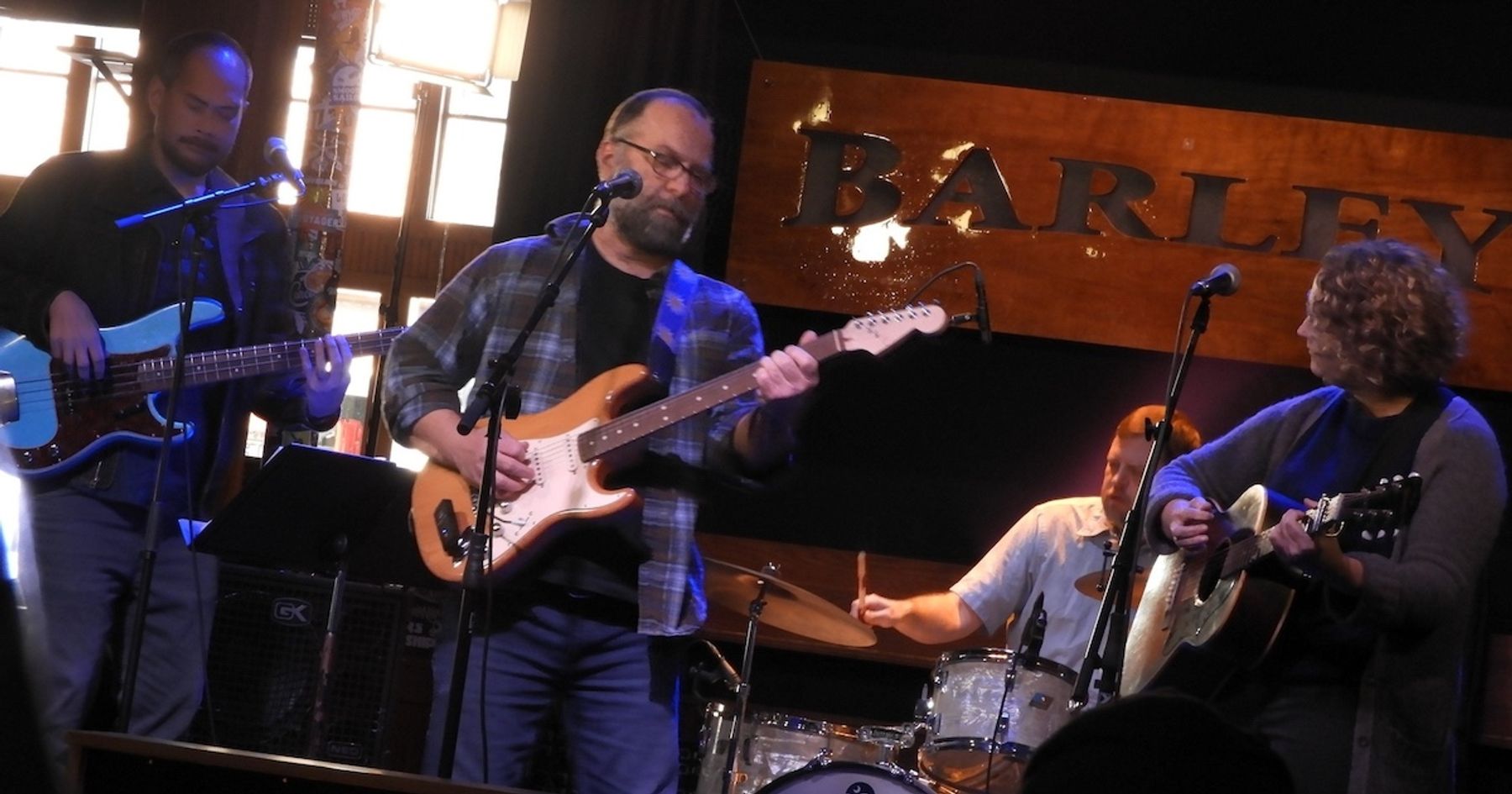
“At the end of the day, when Sean McCollough and his wife, Steph Gunnoe, gather around the dinner table with their daughter, Willa, the conversation inevitably takes a darker turn.Gunnoe, who works in palliative care at a Knoxville hospital, sees it on a daily basis. They’re caring for elderly parents, one of whom — Gunnoe’s mother — has slowly slipped away as dementia has ravaged her mind. On their way to a gig with their band, The Lonetones, they survived a devastating car crash a few years back that left Gunnoe hospitalized for almost a week with broken ribs, a fractured sternum and a punctured liver and lung. They’re not as young as they were when they started this musical journey, and they’ve seen death claim close friends, including the late Phil Pollard, a musical force of nature in the Knoxville scene and a frequent collaborator with the couple.It’s little wonder, then, that some of that darkness makes its way onto “Dumbing It All Down,” the new Lonetones record that the band will celebrate with a Saturday night release show at The Open Chord in West Knoxville.“I do think there are songs that are a total reaction to the preciousness of life and the realization of death,” McCollough told The Daily Times this week. “Aging parents, aging ourselves, car wrecks ... those things give us a new perspective on life, and they played a part, for sure. It’s like the song ‘Sweet Sinners’ — that’s kind of about our dinner conversations. We’re all here, ultimately, for a short time. We’re all sweet, and we’re all sinners, and we’re all doing the best we can, and we haven’t figured it all out.”Here’s the thing about “Dumbing It All Down,” though: It’s not a dark record. Yes, it touches on some metaphysical themes, but the intricate instrumentation, combined with McCollough’s soothing baritone and Gunnoe’s lilting alto, manage to package up melancholy and depression and turn them into a rumination on the yin and yang of life on Planet Earth. Yes, bad things happen; yes, there is pain. But misery is optional, and the sun will indeed rise every morning. A Lonetones record, in other words, sums up the bottom line: No matter what happens, it’s going to be OK, one way or another. Life may not work out to the expectations of those who experience it, but solace and comfort can be found when the shadows descend, if one knows where to look.And music, they said, is as good of a place as any to start.“It’s like, you show yourself, through your inner child, that the follow-through is really powerful,” Gunnoe told The Daily Times. “It sends a message to these really scared parts of yourself that it’s OK, that it’s worth it, that you’re worth it. Really, it helps you move on.”“I think there’s a a value in writing a song or a poem or painting a painting just for yourself, and we both sometimes do that,” McCollough added. “But there is also value in putting it out into the world, and a vulnerability that comes with that, that’s powerful and healing.”The Lonetones grew out of a chance encounter between Gunnoe and McCollough at Barley’s Knoxville in the Old City in 2000; a West Virginia native, Gunnoe had recently moved to Knoxville for graduate school and quickly became a fan of the local roots music scene. McCollough was a part of that scene, having played in the band Evergreen Street with Geol Greenlee and Pollard, and after connecting romantically and musically, they formed a duo. (Their first public gig was at a wedding at The Palace Theater in downtown Maryville.)Over time, they filled out the lineup, one that’s changed a number of times over the years, and released a handful of records: “Useful” in 2004, “Nature Hatin’ Blues” in 2006, “Canaries” in 2009 and “Modern Victims” in 2012. That record was released in late 2012, so while it hasn’t been quite five years since the last Lonetones album, both McCollough and Gunnoe acknowledge that the wait has been longer than expected.“That car wreck happened right on the heels of us buying and renovating a new house, and part of that meant creating a new recording studio in the house,” McCollough said. “We were kind of ready to record an album when we did all of that, but it pushed it back by about a year and a half. But we ended up with a nice space in our house to record.”At their former home, the studio was located in the basement, where a wood stove made winter recording sessions impossible because of the heat. In addition, the acoustics were often so difficult that McCollough spent more time cleaning up recordings on the computer than his bandmates did laying the recordings down.“With ‘Dumbing It All Down,’ I didn’t have to sit there and work on them to make them sound nice,” he said. “The space has been a real added benefit.”Another benefit — new players in the Lonetones lineup. Jamie Cook, formerly of the Black Lillies, is the band’s new drummer, and Vince Ilagan and Bryn Davies are splitting duties on bass. Cecilia Miller is the lone holdover from “Modern Victims”-era Lonetones, but her expanded role on the new album adds a sweeping sense of majesty to many of the songs. And when all of the members contribute to the arrangements of certain songs, the results are sublime. Local jazz man Will Boyd pitched in for the song “Of Course,” which Gunnoe initially brought to her husband as a song she was unsure belonged on the album.“It was this sad song that was really super raw that I brought to Sean, and he’s like this benevolent, wonderful dad, and you know it’s not going to be too much for him,” Gunnoe said. “He said something like, ‘It’s going to be OK. We can work with this.’ And I said, ‘We can work with that? It feels so dark and heavy!’”“It’s a heavy song, lyrically, and Steph was pretty set on the fact that this was maybe a song we couldn’t ever perform or do with the band,” McCollough added. “But the band came together and played around with it, and we put it to a sort of disco, roller-skating vibe, and it surprisingly came out sounding like it sounds. It was a community effort that turned it into what it is, and you come away from it feeling hopeful, even though the lyrics are heavy.”And that cuts to the core of The Lonetones sound. Life happens, and it’s not always a pleasant experience. But with albums like “Dumbing It All Down” to get us through, we’re going to be OK.“I’m pretty busy, and I’ve got a lot of nice parts to my life, and I don’t want to mess around with the art unless it’s going to serve a purpose,” Gunnoe said. “Sometimes, I kind of wish I didn’t have to do it. It’s a lot of work, it doesn’t pay any money, and it takes you away from other things. But there’s nothing else quite like it to serve its purpose, and because of that, we can’t not do it.”” - Steve Wildsmith
“THE LONETONES PUT NO RESTRICTIONS ON THEIR NOTES Anyone who's witnessed the maturing of the Lonetones over the past several years knows it's a group that isn't hemmed in by any boundaries. The group may have begun sounding like a sweet little folk outfit, but over the course of four albums (including the brand new "Modern Victims"), the Lonetones have developed into a genre-bending group that doesn't quite fit into any niche and instead feels right almost everywhere. If the band has a spiritual equivalent in a better-known act, it would have to be Wilco. It's nice to have a band that's up for wherever it goes," says co-lead singer-songwriter Steph Gunnoe, sitting at her dinner table with husband and co-lead singer-songwriter husband, Sean McCollough, at the couple's South Knoxville home. The rest of the members also added to the changes with Maria Williams playing electric bass rather than just acoustic, Steve Corrigan coming up with new things on drums and new member Cecilia Miller adding cello parts. The songs have definitely evolved," says McCollough. "For us, it feels a lot different than the last one. We were hearing things in our heads that we hadn't done before and we had to figure out how to make them happen. I'd just started playing electric guitar and different things come out of you — even different emotions that you wouldn't write about if you were writing on an acoustic guitar," says Gunnoe. "It's nice to just be able to follow the song. Growing up in West Virginia, my dad played the banjo and I was comfortable with rural forms of music, and that's probably where I sing best, in a way, but I felt a little mismatched," says Gunnoe. There was a definitely an indie rock phase in Gunnoe's past, despite being into the folk scene when she and longtime singer-songwriter/children's artist McCollough met in Knoxville. These days, Gunnoe and McCollough let all their influences shine. They've also opened up with how they create songs. The two don't typically co-write (the couple's first true co-write is the new song "Alone"), but they do share their songs and accept suggestions. Our brains work very differently," says McCollough. I'm really interested in the scary part of songwriting," says Gunnoe. "I'll go into the darkness and then show it to Sean and he'll say 'cool' and then do something great with it. He's got bigger ears than me in some ways. She goes deep and I go wide," says McCollough with a chuckle. The "Modern Victims" title cut is the first time in which the writer of the song didn't perform the vocals on the number. Gunnoe wrote it, but McCollough sings it. I just never felt like I could pull the song off," says Gunnoe. "I wrote this song and I liked it, but it doesn't sound like me. I wrote it and pitched it as a rap song ... And then I turned it into a power ballad and put the rap in the middle," says McCollough. "It sort of feels like MY song now. Local rap great Black Atticus free-styles near the end of the track. We just gave him a blank spot," says Gunnoe. The album is dedicated to friend and former Lonetones member Phil Pollard, who died in October of 2011. McCollough also added bits of Pollard's music in parts of the new album. The song 'Top Hat' is something I wrote a couple of weeks after he died," says McCollough. "It's about how his death brought so many people together. He was the kind of a guy who would just send you a text that said 'I love you.' Afterwards, people acted a little more like Phil had. Although the group has done some out-of-town touring, the membership's full-time day job status keeps them close to home, but word on the band seems to be getting out. I'd be lying if I didn't say it would be cool to have some windfall success," says Gunnoe. "Some part of me would like that. But in some ways it's almost like it's Sean's and my relationship. It's a weird machine that works for us. It's a whole other plane that we meet on.” - Wayne Bledsoe
“Knoxville's Lonetones are deeply rooted to East Tennessee. With jobs and families cementing the band to mostly local outings, the group seems to embrace home, performing music that is Appalachian at its core. The inherently traditional aura of its sound, however, in no way limits its massive absorption of influences from around the world, drawing comparisons to bands of other genres in other hemispheres. Tonight the socially conscious act will perform for a global cause, benefitting the children of Haiti. There is no denying the folk base of The Lonetone's sound, with musical renaissance man Sean McCollough employing an arsenal of traditional instruments and the band's front porch-vocal harmonies. Despite its mountain-folk heritage, the group has been likened to a number of indie-rock outfits, the most abstract of which being the key-heavy Scottish act Belle and Sebastian. Perhaps more noticeably, the Lonetones are reminiscent of Swedish indie-poppers Acid House Kings had they been reared in Melungeon territory. Ever open to listener interpretation, the group is accessible to a wide array of fans and comfortably fits nearly any venue Knoxville can offer. I love to drone," McCollough points out. "I drone on the banjo, the mandolin, the guitar and keyboards. I love finding one or two notes that I can play through an entire song and then build layers on top of that. One band I associate with this idea is The Velvet Underground. Their music has heavily influenced what we think of as indie-rock. So perhaps this is related to where the term indie-folk has come from. Of course, the demographic draw at different venues is a reality - younger folks come to an 11 o'clock show at the (Preservation) Pub; older folks come to an 8 o'clock show at Barley's. But, as musical styles continue to mix and create this wonderful mish-mash that we call American music, I really think that the distance between what can happen at the WDVX Blue Plate Special at noon and what goes on at the Pilot Light at midnight is really not as far as some people might think. I marvel at the diverse fan base The Lonetones gather," adds vocalist/guitarist Steph Gunnoe. "All ages, all persuasions - festivals are usually a good fit for us for this reason. We have played at the Pilot Light only once before, and I would rate it highly as a stage to be free on. We have probably played the most shows on WDVX and have a real home there, a welcoming audience that permits our experimentation. We kind of tailor our sound to the venue - clean it or dirty it up musically. With two albums to their credit since 2003, The Lonetones are gradually accumulating tracks for a third they hope to release later this year. Due to the band's low-pressure, DIY approach to recording, albums tend to sprawl a lengthy period of time, which may account for the discernible evolution between and within each record. We're slowly beginning to record our next album," McCollough notes. "We have recorded our last two at home and will do so again. It gives us the luxury of taking our time and experimenting. For tonight's gig, The Lonetones will be joined by Kevin Abernathy, a familiar face bringing an unfamiliar aspect to the group's dynamic, adding his electric guitar to the band's earthy sound. The Lonetones will perform at Pilot Light in a benefit for the Haitian Pedagogy Institute. Co-founders Sara Elizabeth Malley and Kymberle Kaser put HPI together with the mission of funding and establishing self-sustaining schools and free secondary education for the children of Haiti.” - Jer Cole
“WHO NEEDS "BIG TIME" WITH FANS AND FRIENDS RIGHT HERE?The Lonetones are anything but lonely.The folk music quartet is flush with friends and loaded with family. The band's sophomore CD, "Nature Hatin' Blues," is ready for release, and the band members know that, in Knoxville, they'll have local radio support and a waiting audience....” - Wayne Bledsoe
“LONETONES HAVE A THING FOR NATURE....It's more than just a statement about Mother Nature; it's a treatise on human nature as well: "I've got the nature hatin' blues / each time we win we surely lose / the signs and symptoms can be found / disharmony bringing us down / I wanna bring it back, I wanna fit back in / I wanna be a part of nature again ...""We spent a lot of time thinking about what we do to the environment and ourselves," Gunnoe told The Daily Times this week. "I just think we kind of hate our own nature, and when we sort of deny ourselves, we deny nature at the same time. It's meant to look at both, because it's hard to separate them.” - Steve Wildsmith
“FROM SEATTLE TO DOWN SOUTH, GUNNOE'S LONETONE JOURNEY A HAPPY ONEBut for a few fateful turn of events, Stephanie Gunnoe might be playing electric guitar and screaming into a microphone as part of a riot-grrl group out of the Northwest.Instead, Gunnoe picks sweet acoustic guitar and sings gently as part of The LoneTones, the band she fronts with her husband, singer-songwriter Sean McCollough (who also fronts the local band Evergreen Street). The band plays gentle acoustic music rooted in Gunnoe's Appalachian heritage ... but hearing her story, it's not a stretch to see how she might have ended up signed to Kill Rock Stars along with the label's star band, Sleater-Kinney.``I was so happy to discover the riot-grrl scene, and it really, really inspired me,'' Gunnoe said recently of the time she spent in Portland, Ore., Sleater-Kinney's hometown. ``I might very well have ended up in one of those types of bands, but I didn't have the riot-grrl kind of voice and the aggression. I just don't have it, but the whole do-it-yourself attitude inspired me.''Gunnoe's roundabout path to East Tennessee began in West Virginia, where, growing up, she was immersed in music. Her mother sang opera, and her father played the banjo. At the time, she disliked both styles of music, and when she left for college, she chose a place about as far from the West Virginia mountains as she could get -- Washington State.``I hated bluegrass music, and opera for that matter, until I went to college out there,'' she said. ``I guess seeing all these young people enjoy it made me realize how much I loved it.''Eventually, she followed a boyfriend and a best friend to Portland, where she began performing with a fellow singer-songwriter named Little Sue.``We played just kind of raw harmonies, a Hazel-and-Alice type of music,'' she said.At the time, the grunge movement had just exploded out of Seattle, and the riot-grrl movement arose from that scene. But Gunnoe drifted toward the emerging Eastside Sound, an acoustic revival led by former members of the Holy Modal Rounders and The Fugs.``It was sort of an acoustic revival, and those guys sort of grandfathered a whole scene,'' Gunnoe said.Shortly thereafter, homesickness led her back east -- but she wasn't so overcome with it that she wanted to settle back in West Virginia. She settled on graduate school in Knoxville, based in part on its proximity to the mountains that she loved.``I heard WDVX when I was coming down here to visit the college, and just driving through the mountains, listening to some of the songs, was powerful,'' she said.Realizing she'd found a spiritual as well as a geographical connection to her childhood, Gunnoe threw herself into studies at the University of Tennessee and the local roots music scene. Her high, melodic voice seems cut from rough mountain fabric, a thick flannel worn to sweet softness that's warm and comforting at the same time.A chance encounter at Barley's Taproom altered her life when she was introduced to McCollough.``We came back to our house -- my roommate was his friend, so we came home and played some music that night, and we've been playing ever since,'' she said.That was back in 2000, and the two were soon known as Steph Gunnoe and Sean McCollough. Their first public gig was a wedding at The Palace Theater in downtown Maryville, and eventually, the two added Maria Williams on harmony vocals and bass and McCollough's Evergreen Street bandmate, Phil Pollard, on drums.``We were kind of hoping the bigger sound might help us stand up to the noise in a bar,'' she said with a chuckle. ``But it started with just me and Sean. I thought he had just a deep love and understanding of folk music, and somebody said this about him -- and it made a lot of sense -- they said he's kind of a rock 'n' roller but he sort of channels it all into folk music. To me, that's very valuable in the folk music world.''McCollough and Gunnoe were married about two years ago, she said, and The LoneTones began work on their debut album -- ``Useful,'' a collection of songs that's full of mirth, gentle energy and excellent musicianship -- about a year ago.``We started a year ago, and we'd had a baby, so it seemed like a pipe dream at the time to make this record,'' said Gunnoe, whose stepchildren attend school in Alcoa. ``We were pretty deliberate that we wanted to try and keep it true to our sound. It's pretty tempting to make your vocals better and add a bunch of instruments, because Sean can play anything, but we tried to keep it toned down to keep from disappointing people live.''Their success is self-evident, and anyone who listens will most certainly agree -- Gunnoe sounds much more at home singing and playing Americana than she would have been raging through a raucous set of girl-punk.” - Steve Wildsmith
“KNOXVILLE: FROM COUNTRY ROOTS TO SLUDGE METAL"The LoneTones specialize in a singular approach to Appalachian pop that's almost unimaginably sweet and certain to please even the most discerning fan of Americana, alt-country and old-time string ensembles. Soulful songwriting and elegant arrangements abound on the band's two full-lengths, especially 2006's "Nature Hatin' Blues," which at moments evokes the sense of an Appalachian Belle and Sebastian — only better. The band is composed of Steph Gunnoe on guitar and vocals, Sean McCollough on guitar, mandolin, banjo and vocals, bass player Maria Williams, Steve Corrigan on drums and glockenspiel, and drummer emeritus Phil Pollard. This group is a true musical gem.” - Andy Kessler
— msn.com